Date
2026.01.29
By
Bouygues Construction's Press Department
Category
Press release
Bouygues Construction built one of the world's first post-tensioned timber bridges to protect biodiversity
Through its subsidiary, VSL International, Bouygues Construction has contributed to building one of the world’s first bridges in post-tensioned timber.
Located in Switzerland between Zurich and Bern, this wildlife crossing, commissioned by the Federal Roads Office (ASTRA) spans the motorway and the Koppigen cantonal highway. The structure enables wildlife to cross the road linking Zurich and Bern safely. Until now, there had been an insurmountable barrier between two natural areas. The restoration of ecological connectivity made possible by the Koppigen bridge helps reduce the fragmentation of natural habitats and limit the number of collisions between wildlife and vehicles, which is damaging for biodiversity and road safety. Covered with approximately one metre of earth and vegetation, the bridge forms a continuous ecological corridor.
Technically speaking, the project presented the unprecedented challenge of building a post-tensioned structure using timber, a bio-based material entailing low carbon emissions. The timber superstructure consists of two spans, including the 37-metre main span, which support a concrete slab, backfill and a covering of earth and vegetation. The heavy loads generated by this configuration required the use of post-tensioning technology, a method that had previously been rarely employed in timber structures.
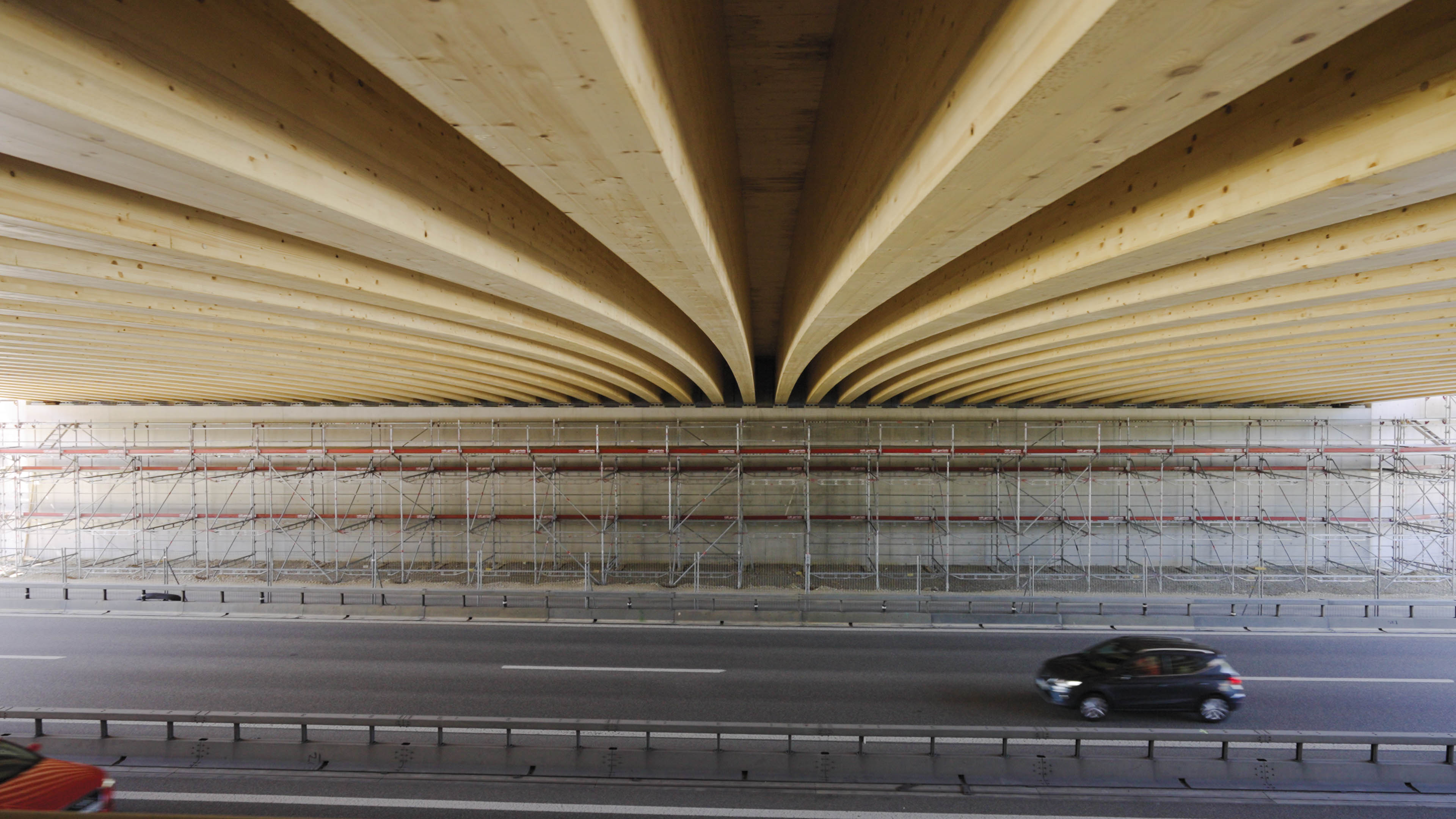
The VSL International team adapted technology that was originally developed for concrete for application on timber. They designed a customised solution based on a large steel plate equipped with numerous small anchorages. This allowed high post-tensioning forces to be distributed evenly without damaging the timber.
The project draws on several years of research and testing carried out in Switzerland, in collaboration with the Higher Technical School of Wood, Biel, and ETH Zurich. These studies confirmed the benefits of post-tensioning wood, particularly with regard to enhancing its load-bearing capacity, reducing deformation and making long-term maintenance easier.
By demonstrating that timber can be used for complex, highly stressed infrastructure projects, Bouygues Construction is paving the way for new low-carbon construction solutions that combine technological innovation with structural performance. Bouygues Construction has been involved in the construction of a number of landmark projects, such as the Hong Kong–Zhuhai–Macau Bridge in China and the Simone Veil Bridge in Bordeaux, France.
Recommended Reading
Explore our latest events, news, and sustainability initiatives below.
Bouygues Construction inaugurates Scale One, a full-scale innovation platform for the construction sector
Bouygues Construction continues the modernisation of Yopougon University Hospital, one of Ivory Coast's largest medical facilities
Appointment of Clotilde Solier as Chief Financial Officer of Bouygues Construction